Not everyone cares about truth. I don’t mean to insult or belittle anyone. Some people I’ve talked to don’t believe that truth really exists in certain areas, or if it does, there’s not a good way to separate truth from opinion. This article isn’t really about religion, but I want to use it as an example. Is there a God? If so, what is he? It’s important to respect everyone’s beliefs about God. However, he can’t be one thing for you and another thing for me. If so, he doesn’t really exist except in our own imagination, which is what many people have come to believe. If he truly exists, as I believe he does, then he has certain attributes. These attributes are completely independent of what you or I believe. Truth encompasses facts that are able to stand alone.
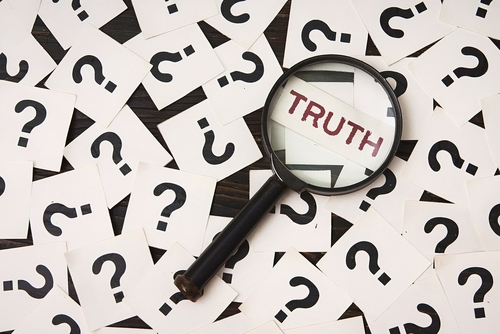
It’s difficult to find truth within healthcare. No matter how confident a doctor may sound, much of what he or she says is opinion. It’s generally opinion based on available facts, as well as their training and expertise, but it’s seldom based on absolute truth. The word diagnosis is based on two base words – dia, which means through, and gnosis, which means to know something. So, a diagnosis implies that the doctor knows what’s going on inside of you. Sometimes the answer is obvious. An X-ray, for example, can show a fracture of a bone (if it’s an obvious break). In that case, the doctor can truly see inside of you and know what has happened. So, the bone fracture would be a true diagnosis. In most cases however, it’s not that obvious, especially with physiological issues. The doctor will often have to use a “working diagnosis”, which is basically an educated guess. Frequently, the confirmation of the diagnosis is found in the reaction to the treatment that is prescribed.
As a healthcare provider who uses energy work, I have to bring muscle testing into the discussion. Muscle testing is not infallible, but it is another method of getting closer to the truth of what’s happening with a person’s body and mind. If you’re familiar with muscle testing as part of energy work, you’ll know that it’s a method of getting information from a person’s subconscious mind. The subconscious mind is in touch with everything that’s happening in a person’s body. It can be a treasure trove of information that’s very helpful for managing a person’s health.
A lot of people don’t believe in muscle testing. (I didn’t used to!) That’s sad, because they’re missing out on a great way to help manage their health. Then there are some people who put too much faith in it and get carried away. There are limitations with it. For instance, it cannot…
- Provide information that is not in the consciousness of either the tester or the subject (in most cases)
- Predict the future
- Effectively be used to make major life decisions.
Another weakness that it has is subjectivity. If the practitioner is not open-minded or if they think that they already know the answer, the results of the muscle testing can be swayed by the attitude and beliefs of the practitioner (and even the subject). Anything that can be done to increase the objectivity of the testing will improve the results of the testing, as well as the appropriateness and effectiveness of whatever treatment is done based on the findings of the muscle testing. This is one of the main reasons why I developed the Vital Balance Technique. This is an enhanced muscle testing and energy balancing technique, which generally uses basalt to focus attention on a particular body part. For more information on the Vital Balance Technique, please refer to my book. It can be purchased on Amazon.
Effective healthcare relies on truth – an accurate understanding of what’s happening in the body and what’s best to be done to assist it. There are a variety of methods to gather information about the body. On the conservative (medical side), there are lab tests, imaging (X-rays, MRI’s, etc.), orthopedic tests, and so forth. On the more liberal/progressive side, there is muscle testing, electronic scanning, etc. It isn’t necessary to pick a side. Bias should not prevent a person from obtaining information in any way from a reputable source. The more information you can gather and interpret correctly, the closer you can get to the truth about the body. Then the more effectively you apply that truth, the better health you’ll enjoy.
Tags: energy work, health, healthcare, muscle testing, truth, wellness


Leave a Reply