First of all, I want to explain why I’m writing this. I have started and stopped a number of times, fearing that I would be misunderstood. And yet, I believe it’s important that I convey this information. I don’t want anyone to misuse this information to excuse unhealthy behavior or to just give up and stop trying to do the right thing. However, there are two main reasons why it’s important to understand the principles that I will be discussing here. First, it will help us to be less judgmental of other people. Secondly, it will help you to not be so hard on yourself. It’s not healthy to constantly beat yourself up about your shortcomings.
We like to think that we are consciously in charge of our words and actions. (It would be nice if we felt like we were totally in control of our emotions, but most people realize that they are not.) So, it can be very hard to understand why we do and say the things that we do. Our conscious thoughts and intentions don’t always match up with what actually happens in our life. Why is that? And what’s up with all those other people? Are they crazy? Why do they think the way they do and do such ridiculous things? After all, they have their free will. So why don’t they use it more responsibly?
The mind is such a complex thing. Back in high school, I was planning to become a psychologist. But then I realized that the mind is something we can never understand and therefore it seems like an overwhelming task to try to fix what’s “broken”. So I went the more physical route. I thought about becoming a medical doctor but I decided that I didn’t like their philosophy. So I became a chiropractic physician instead. However, after many years of practice, I found that body, mind and spirit cannot be separated. In order to treat people effectively, I have to address all three.
There is a great deal that goes into a person’s mental and emotional make-up. Let’s look at some of these, which will help to clarify why the mind is so complex. First, I believe we lived as spirits before embarking on this mortal journey here on earth. We experienced a great deal there. In addition to learning, I believe there were some emotional traumas there as well. Although we don’t remember this previous period of our existence, we still carry personality traits and perhaps a few emotional scars. (If you don’t believe this, that’s okay. I have plenty more to share.)
When we’re born, we carry our parents’ DNA. We inherit many traits from them. We’re finding that some of your personality can also be inherited. Epigenetics is an exciting new branch of genetic science that shows that bits of what your parents learned and experienced can be passed along to you. We see this in children that were adopted at birth. They often display mental and emotional characteristics similar to their birth parents, even though they weren’t raised by them. Some parts of the way that we think are passed down to us genetically.
And then of course, there is the way in which we were raised. The first few years are especially impactful, although we are shaped by the entire growing up experience. It’s not just what we’re taught, but we pick up on the attitudes of our parents, their mannerisms, and how they treated us. Sometimes there is physical, mental or sexual abuse. Sometimes we just don’t feel loved or important. We can adopt our parent’s attitudes toward money and other people. All of these things contribute to who we are when we grow up.
Then there’s the brain itself. It is sensitive to physical trauma, disease, toxins, heavy metals, and a host of other factors. My earliest exposure to this issue came when I was a young adult. An acquaintance told me about their father – about how he had always been a very kind, honest, decent person. Then one day he suddenly started to change dramatically and inexplicably. He became mean and would scream foul language at his wife and children. He started drinking and carousing with other women. He was a totally different person. But then he died. Right before he died, they discovered a brain tumor that was affecting the portion of his brain that governed good judgement and behavior. He couldn’t help what he had become and how he was acting.
I admire the work of Dr. Daniel Amen. He’s done a lot with brain health and behavioral psychology. A great tool that we have to work with now, which Dr. Amen uses extensively, is the functional MRI. It not only looks at the physical structure of the brain, but the amount of activity in each part of the brain. He can look at an fMRI of a person and tell you the likelihood of certain personality types and behavior patterns. There can be certain parts of the brain that are barely functioning due to trauma, drugs, etc., which have a huge effect on how a person thinks and acts.
Some of the things that happen to our brain (trauma, etc.) cannot be helped. Some traumas and so forth can be prevented by taking proper precautions (such as wearing a helmet with certain activities). There are many issues that can be prevented by making good decisions early on. We are certainly influenced by all the things that I’ve talked about, but we have a lot more conscious control in the beginning before we form habits and addictions (drugs, pornography, etc.). Once drugs, toxins, etc. have done their damage in the brain, it becomes a lot more difficult to think clearly and discipline ourselves to make positive changes in our life.
Some people are very sensitive to the energy of other people. They can pick up trapped emotions or just be altered by other people’s attitudes. So even the people that we hang out with can alter our thoughts and emotions, which then help drive our actions.
After all of that, even if you take away all of the influences that cloud our thinking and judgement, even if we use pure, unadulterated logic, we can only judge according to the facts that we have available. Even then, we can’t always know if all of the data that we’re considering are true. People, even great scientists, have often drawn incorrect conclusions simply because they were acting on incorrect or incomplete facts.
There are other influences that I can discuss, but you get the idea. When you consider all of the factors that determine our personality and our mental and emotional make-up, you may be wondering if free agency, the ability to consciously choose our actions, even exists. Some would say no. Some people believe that we are simply products of our environment. I believe that’s a very defeatist attitude that can prevent many people from achieving their highest potential and joy in life. To one degree or another (varying from person to person), we all have some ability to reason and to act with conscious direction. To whatever extent that is, it’s vital that we use that free agency to choose wisely. Part of this ability to reason is to consider what I’ve been telling you and to understand what makes you the unique individual you are, with all your strengths and weaknesses, your attitudes and beliefs, and all that goes into who you are. That understanding, used properly, can be empowering. Don’t be a slave to what you’ve inherited or what has been done to you, or even to the poor choices you’ve made in the past. Our challenge in life is to rise above such things. Don’t beat yourself up about who you are or have become. Just recognize these factors. Capitalize on your strengths. Avoid, work around, or learn to deal with your weaknesses. There are many tools available to assist you in overcoming the issues that you’ve acquired. The first step is to realize that these issues exist. That right there gives you some power over them. You can succeed and have joy, although it may take a significant amount of effort.
The bottom line, as I see it, is that free will exists. There has been much written about free will vs. determinism or predestination. There are many arguments for both sides. However, I always say that the truth usually exists between two extremes of thought. We must use our free will cautiously and responsibly. However, it’s not fair to yourself or others to imagine that any of us have the freedom to act strictly according to pure logic and clear thinking. I don’t believe it’s possible in our present state. So, take that into consideration when judging yourself or others.
 COVID-19. Have you heard anything about that lately? If you’re like me, you probably hear about that more than anything for the past several weeks. This coronavirus has changed life for the entire world. It’s getting more difficult to maintain patience as we wait for life to return to normal. Personally, my impatience is leading to great frustration, and I’m not even one of those whose life has been totally upended. I’ve been very blessed to keep my business going during this time when so many other businesses have been put on hold. Part of the frustration comes from the growing feeling that the extreme measures that we’ve been subjected to may not have even been appropriate. I’m not suggesting that COVID-19 is not a big deal and should have never been taken seriously. My heart goes out to those who have and are suffering from this horrible illness, and especially to those who have lost loved ones to it. This is not your standard, everyday flu bug. I hear estimates from twice as bad to ten times more deadly than normal influenza. Some see this as something very unique, while others see it as just as a particularly nasty strain in an ever-increasing list of viruses. Whichever the truth is, I believe that it’s time to return to normal life and that perhaps this massive disruption should have never occurred. There are two main reasons for this.
 further where I could easily tell if someone did or did not have this particular brain energy that I have come to associate with indigos. So I believe that my test is reliable for determining if someone is indigo, without having to simply rely on a list of personality traits.
 It takes courage to break free of the pattern of self-pity. It takes an open mind and humility to even see the problem. It means taking responsibility for your life and happiness. It can be much easier to blame your circumstances on everything and everyone around you. If you really need to continue wallowing in your misery a while longer, or if you’re not ready to take charge of your situation in life, then stop reading this. Come back when you’re ready. I won’t judge you.
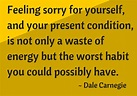 NEVER tell you to give up, stop trying, and just pack it in. Discouragement is one of the first fruits of self-pity. Discouragement makes you just want to give up, to sit down in the middle of the proverbial road and mope in your misery. Once you recognize the patterns of feeling sorry for yourself, then whenever such thoughts come into your mind, you can toss them aside and replace them with “keep moving forward”.
 Do you ever find yourself in a situation that is totally unacceptable and yet there isn’t a darn thing you can do about it? This can be one of the greatest sources of frustration in your life. I like to quote from the Prayer of Serenity used by Alcoholics Anonymous:
 I’ve been getting advice and guidance from Kirk Duncan, a local teacher and mentor. A principle that I learned from him goes like this – self-accountability + self-forgiveness = self-mastery. I really like that. And the more I think about it, the more I’m convinced that this principle is one of the main keys to success for anything in life.
 Dr. Whittaker's Blog